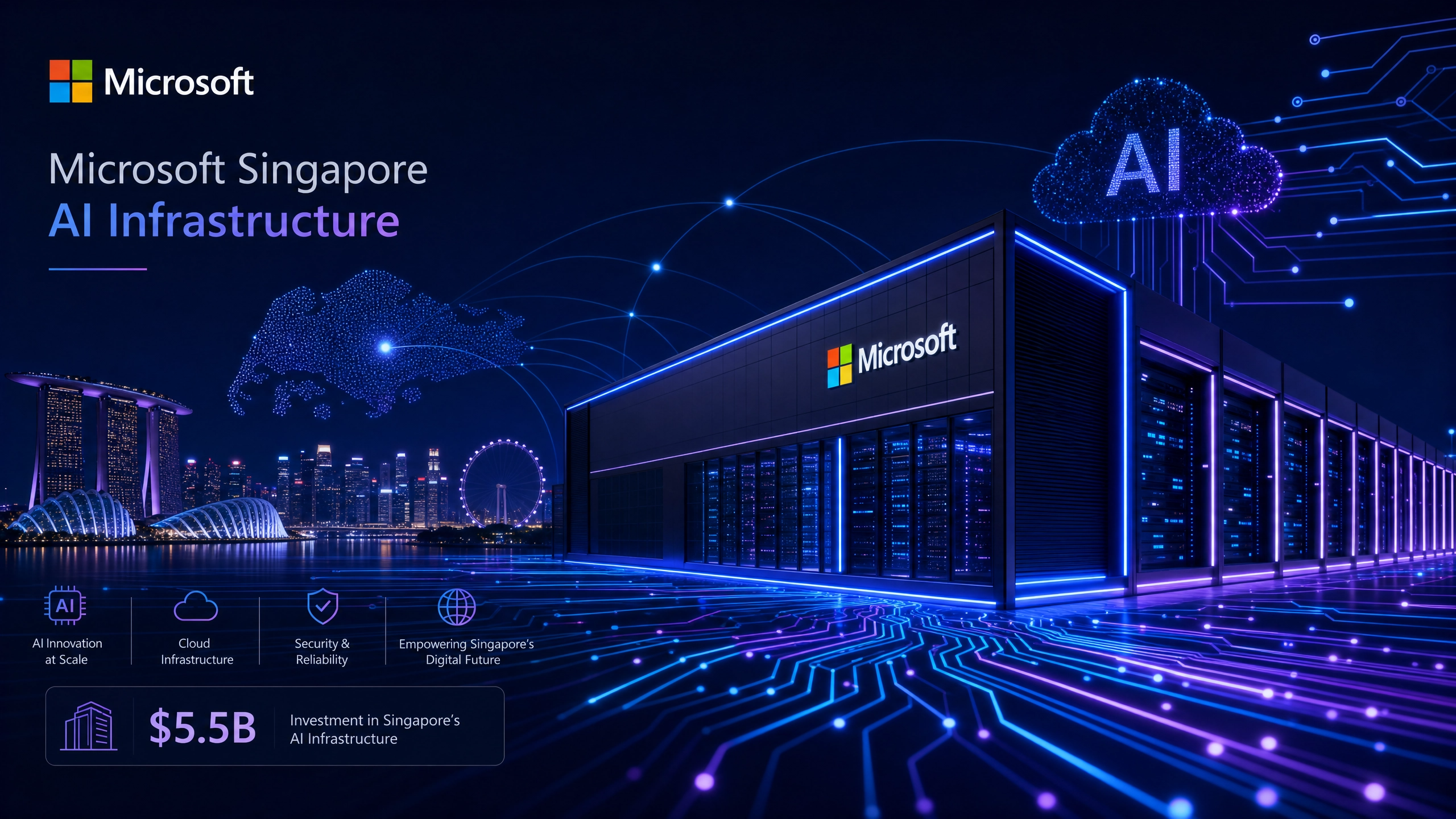
Microsoft just announced a $5.5 billion investment in Singapore's AI infrastructure. On the surface, it sounds like another tech company throwing money at data centres. But dig deeper, and this is a fundamental shift in how AI development happens — and who can compete.
Why Singapore? Why Now?
Singapore isn't random — it's strategic. The city-state sits at the intersection of major tech markets across Asia, Europe, and beyond. Strong regulatory frameworks, excellent connectivity, proximity to growing Asian markets, and political stability make it the ideal anchor point for a global infrastructure play.
By investing here, Microsoft isn't just building servers. It's positioning itself to serve the entire world from a single, strategically placed hub. And more importantly, it's signalling that the infrastructure race is heating up fast.
The Real Impact: Cheaper Compute
Right now, running large AI models at scale is expensive. Microsoft's Singapore investment adds capacity that drives prices down across the board. When compute gets cheaper and more accessible, the barrier to entry drops — your indie startup can compete with companies that have billion-dollar infrastructure budgets.
The Shift: From Software to Infrastructure
The AI gold rush started with software. Everyone wanted to build the next ChatGPT or Midjourney. But the real winners aren't always the software makers — they're the infrastructure providers. The 2010s app gold rush made Apple and Google rich via the App Store and Play Store, not the app developers. The same pattern is playing out in AI: Nvidia, Microsoft, and Amazon are building the rails everyone else runs on.
What This Means for Startups
Lower barriers to entry
Cheaper compute means you don't need $100M in funding to build an AI product. Start smaller, iterate faster, scale when you find product-market fit.
More competition, faster innovation
More startups will emerge as barriers drop. That's net positive — it drives innovation and forces everyone to build better products.
Specialisation wins
As infrastructure becomes commoditised, the winners will be companies building specialised AI for specific industries and use cases — not generic tools. Find your niche.
Key Takeaways
- Microsoft's Singapore investment is infrastructure play, not just a data centre.
- More capacity = cheaper compute = lower barriers for startups.
- The real AI winners are infrastructure providers, not just app builders.
- Specialised AI products will outperform generic tools as the field matures.
The question isn't "Can I build an AI company?" anymore. It's "What problem am I going to solve with AI?" That's the real opportunity this investment unlocks. 🚀
Watch This on TikTok
See the full breakdown in 60 seconds on the loudjack TikTok channel.
Watch on TikTok →